 Joachim Zuther, Lymphedema Specialist.
Compression therapy, like manual lymph drainage (MLD), exercises, and skin care, is a main element of Complete Decongestive Therapy (CDT).
In most cases of lymphedema, the elastic fibers in the skin tissues affected are damaged and unable to provide adequate resistance to the musculature working underneath and to the blood and lymph vessels within these tissues. External compression compensates for the elastic insufficiency of the affected tissue, providing the resistance necessary to maintain the reduction of the swelling and to prevent re-accumulation of lymphedematous fluid.
 Compression bandages are used during the decongestive (intensive) phase of CDT. In this sequence of the treatment the volume of the affected limb changes almost on a daily basis, and it is necessary that external compression adapts to these changes. Bandages are much better suited for this task than compression garments (sleeves, stockings), which would have to be re-fitted constantly. Garments are used in the second phase of CDT, when the limb is decongested and volume changes are minimal.
Why short-stretch bandages?
Crucial in lymphedema management is to provide the skin tissues with a solid counterforce against the muscles working underneath, particularly  while standing, sitting, walking, or performing therapeutic exercises. The subsequent increase in the tissue pressure during muscle activity promotes lymphatic and venous return and prevents fluid from accumulating in the skin. It is equally important to prevent the bandages from exerting too much pressure on the tissues during rest, which could cause a tourniquet effect and effectively prevent adequate return of these fluids.
There are two distinct types of compression bandages – short-stretch and long-stretch bandages. The difference refers to the extent the bandages can be stretched from their original length. Short-stretch bandages are made from cotton fibers, which are interwoven in a way that allows for about 60% extensibility of its original length, whereas long-stretch bandages, commonly known as “Ace” bandages contain polyurethane, which allows for an extensibility of more than 140% of the bandages’ original length.
The extent of which a bandage can be stretched specifies the two main qualities of pressure in compression therapy – the working pressure and the resting pressure. The working pressure is determined by the resistance the bandage provides against the working musculature underneath, and is active only during muscle activity, and therefore temporary. The pressure the bandage exerts on the tissues at rest, i.e. without muscle contraction is known as the resting pressure, which is permanent. Relevant to these pressure qualities are the number of bandage layers, the tension with which these layers are applied, and most importantly the type of bandage used.
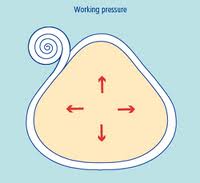 The high working pressure of short-stretch cotton bandages provides the necessary solid counterforce and make them the preferred compression bandage in the management of lymphedema. Due to the low resting pressure of short-stretch bandages, tourniquet effects are prevented – provided these bandages are applied correctly.
Long-stretch (“Ace”) bandages have the exact opposite effect and are not suitable for lymphedema management. The low working pressure these bandages provide does not offer adequate resistance, and fluid would inevitably accumulate. In addition, the high resting pressure of long-stretch bandages could constrict veins and lymph vessels during rest.
Dear Lymphedema Blog Reader – if you like the contents on this website, please help to keep it going. A great amount of work and research is necessary to provide you with up-to-date information on this site. Your donation supports these efforts and associated administrative costs. Surplus funds will be donated to Lymphedema/Lipedema-related charitable endeavors. Please donate using the “Donate Now” button on the right upper hand of this page – Thank You!
Join Lymphedema Guru, a Facebook page solely dedicated to inform about all things related to lymphedema – news, support groups, treatment centers, and much more