
 Joachim Zuther, Lymphedema Specialist.
Lipedema is a chronically progressive, symmetrical accumulation of fat in the subcutaneous tissue occurring almost exclusively in women. Primarily, the lower extremities are affected, but lipedema may occur in combination with the upper extremities as well. Lipedema is characterized by symmetric enlargement of the limbs, combined with tenderness and easy bruising.
Lipedema is not caused by a disorder of the lymphatic system; however, it is commonly misdiagnosed as bilateral primary lymphedema.
Several marked differences between lipedema and primary lymphedema can be distinguished; these differences are highlighted in the table below.

Lipedema
While lipedema always affects both legs symmetrically (bilateral appearance), primary lymphedema usually affects one leg only. If both legs are involved in primary lymphedema the swelling appears asymmetric (see image on bottom of this article). The feet are not involved in pure lipedema; the symmetrical distribution of fat is located between the hips and the ankles.
In contrast, the feet in lymphedema are involved in the swelling, and a diagnostic indicator known as the Stemmer sign is positive (see image below).
The Stemmer sign is a diagnostic test that involves pinching the skin on the upper surface of the toe (usually second toe) or fingers. If a fold of skin can be pinched and lifted up at the base of the second toe or middle finger, the Stemmer sign is negative. The Stemmer sign is positive and indicative of lymphedema when a skin fold cannot be lifted, but can only be grasped as a lump of tissue. This sign will become positive if lipedema develops into lipo-lymphedema. Circumstances that can lead to lipedema developing into lymphedema are explained in a previous post.
Tissue in lipedema has a soft rubber-like feel in early stages and may include small fatty lumps (nodules) within the tissues in
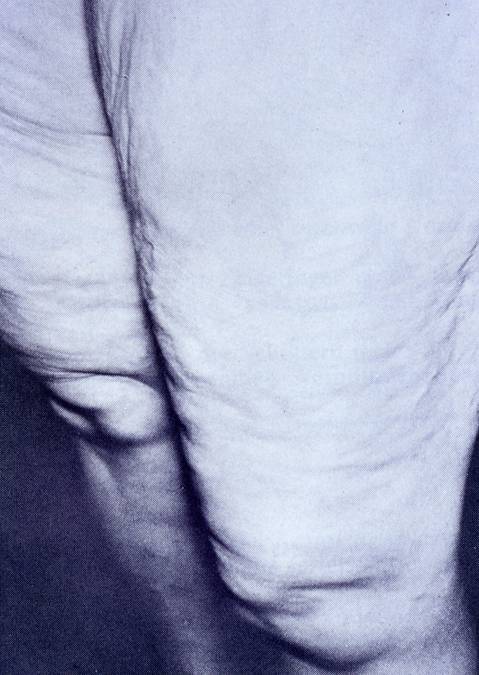
Fatty nodules in lipedema
later stages. Pressure with the thumb does not leave an indentation (no pitting) in lipedema. Lymphedema is pitting and the tissue feels firmer that the one in lipedema, especially with fibrotic tissue typically being present starting in stage 2. The cause for the onset of lymphedema are malformations of the lymphatic system, while he underlying cause for the development of lipedema remains unknown; it is thought to be associated with hormonal disorders.
Differences at a Glance
| Lipedema | Lymphedema |
| Symmetric (buttocks involved) | Not symmetric |
| Foot not involved | Foot involved |
| Not pitting | Pitting edema |
| Stemmer sign negative | Stemmer sign positive |
| Tissue feels rubbery | Tissue feels firmer (starting stage 2 lymphedema) |
| Painful to touch | Generally not painful to touch |
| Easy bruising | Generally not bruising |
| Hormonal disturbances frequent | Generally no hormonal disturbance |
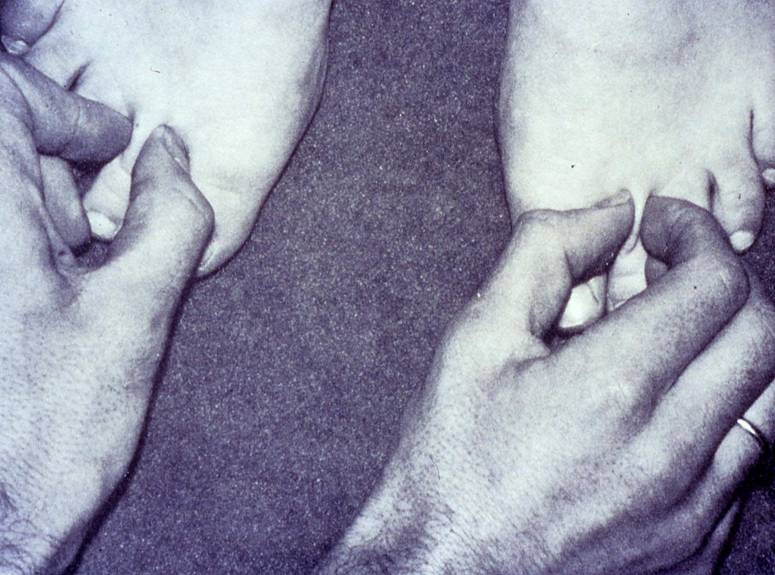
Stemmer sign; positive on left
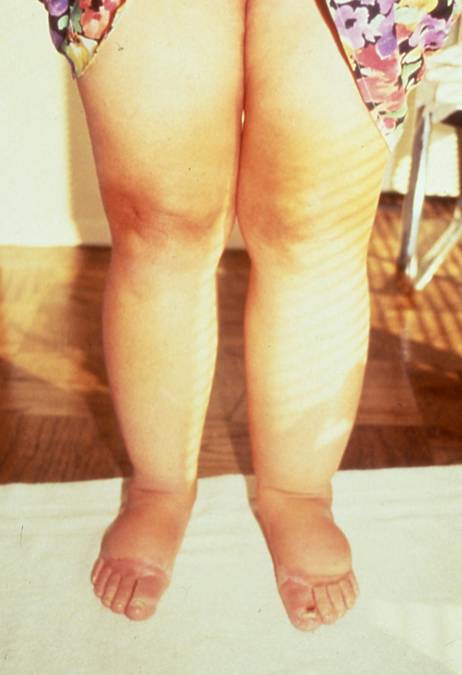
Primary bilateral lymphedema
Dear Lymphedema Blog Reader – if you like the contents on this website, please help to keep it going. A great amount of work and research is necessary to provide you with up-to-date information on this site. Your donation supports these efforts and associated administrative costs. Surplus funds will be donated to Lymphedema/Lipedema-related charitable endeavors. Please donate using the “Donate Now” button on the right upper hand of this page – Thank You!
Join Lymphedema Guru, a Facebook page solely dedicated to informing about all things related to lymphedema – news, support groups, treatment centers, and much more
Additional Reading: