
 Joachim Zuther, Lymphedema Specialist.
During the past several years various techniques of elastic taping have become popular adjunct treatment modalities for lymphedema. While elastic taping has been applied for many years to treat conditions such as sports injuries or orthopedic problems, recent studies and patient reports indicate that this technique may also be a useful tool in the treatment and management of lymphedema.
The original technique, Kinesio Taping®, was developed in the 1970s by the Japanese chiropractor Kenzo Kase. Based on this original technique a number of other taping variations have evolved, and different taping products were developed by a number of manufacturers. All taping products have very similar properties; manufactured with woven cotton fibers, the material has characteristic stretch properties that closely resemble the stretchability of the skin. It is held in place by a hypo-allergenic and latex-free medical-grade acrylic adhesive, which is heat-activated.Perforated with numerous holes the tape allows air to circulate, and while the tape’s cotton fabric will absorb water, the acrylic adhesive next to the skin is waterproof. This enables the patient to shower and swim with the material in place.
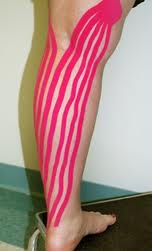 The idea behind the tape is to apply a gentle lift on the skin, which then allows the lymphatic vessels underneath to absorb and drain lymphatic fluid from the edematous area into an area with sufficient lymphatic drainage. The goal of this method is to re-direct the flow of lymph from a congested area into an area with sufficient lymphatic flow, thus reducing the volume of the edematous area.
Elastic tape is available in rolls of various widths, or pre-cut shapes; the length and pattern of the application depends on the individual situation and drainage pattern, and takes into consideration additional barriers such as scars and other defects on the skin.
The tape is applied to the skin with slight stretch (just to the tension required to remove the backing) and with the patient’s skin in stretched position. 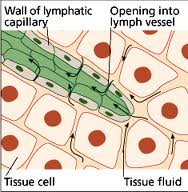 Once the skin returns to the resting position, the tape rebounds, and if applied correctly, rippling convolutions in the tape will become visible. This desired effect deforms the skin and slightly lifts it from the fascia below in order to create a pull force on the filaments anchoring the small lymph vessels within the tissues. This pull force creates openings in the wall of these vessels, which allows more fluid to enter the lymphatic system and subsequently increase lymphatic flow away from the swollen area. By positioning the tape correctly, it is possible to facilitate and channel the lymphatic fluid in the desired direction without restricting muscle and joint movements.
Additional stimulation of the lymphatic system is achieved as the patient performs movements in daily activities, or performs decongestive exercises as instructed by the lymphedema therapist. The tape can be worn several days as long as there are no negative reactions on the skin.
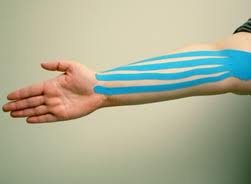 The fact that elastic tape can be worn underneath compression bandages and garments makes it an attractive addition to the gold standard for the treatment of lymphedema, complete decongestive therapy. It is particularly useful in areas affected by lymphedema where bandaging is difficult, or not possible, such as lymphedema affecting the head and neck (see also link “Use of elastic taping in the treatment of head and neck lymphedema” below).
As with any treatment modality for lymphedema, it is important to understand that the tape should be applied by a trained therapist with a thorough understanding of lymphedema. Local contraindications, such as adverse reactions to the tape, radiation fibrosis, wounds, lymphatic cysts and fistulas, as well the risk of damaging the fragile skin of lymphedema patients is a concern to be considered when using elastic taping.
The therapist will instruct the patient to properly remove the tape after several days. The adhesive bond of the tape is best broken by holding up an edge of the tape and gently pushing down on the skin to dislodge it from the adhesive. The use of oil helps to neutralize the adhesive, and removal of the tape in direction of the body hair minimizes the risk of skin irritation.
Dear Lymphedema Blog Reader – if you like the contents on this website, please help to keep it going. A great amount of work and research is necessary to provide you with up-to-date information on this site. Your donation supports these efforts and associated administrative costs. Surplus funds will be donated to Lymphedema/Lipedema-related charitable endeavors. Please donate using the “Donate Now” button on the right upper hand of this page – Thank You!
Join Lymphedema Guru, a Facebook page solely dedicated to inform about all things related to lymphedema – news, support groups, treatment centers, and much more