

 Joachim Zuther, Lymphedema Specialist.
Lymphedema is a common late effect of cancer treatment in the head and neck region and may develop in a variety of external and internal anatomical locations of the head and neck.
As with lymphedema affecting other areas of the body, most often the upper and lower extremities, secondary lymphedema of the head and neck is caused by a disruption of the normal flow of lymph following surgery and/or radiation for cancer treatment. Impaired lymphatic function is often exaggerated by the formation of scar tissue.
 The swelling can be just as severe as those experienced by individuals following treatment of breast and other types of cancer. Lymphedema in patients with head and neck cancer can be very disfiguring, cause functional problems and severely impact the quality of life.
A recently published study on the percentage of the population (prevalence) affected by secondary lymphedema after head and neck cancer treatment from the School of Nursing at Vanderbilt University in Nashville, TN (1) included 81 patients with head and neck cancer who were three months or more post treatment. The study reported that of these 81 patients, 75.3% (61 of 81) had some form of late-effect lymphedema of the head and neck region. Of those, 9.8% (6 of 61) only had external, 39.4% (24 of 61) only had internal, and 50.8% (31 of 61) had lymphedema affecting both internal and external structures.
Another study from the University of Pennsylvania School of Medicine (2) reports that out of a study population of 270 patients, 30% of whom were treated with radiation therapy, 9% with surgery alone, and 61% with surgery and radiation therapy, the neck was the most common site of lymphedema (89%), followed by the submental (below the chin) (84%), facial (32%), and intraoral (6%) areas. Some patients had more than one affected area.
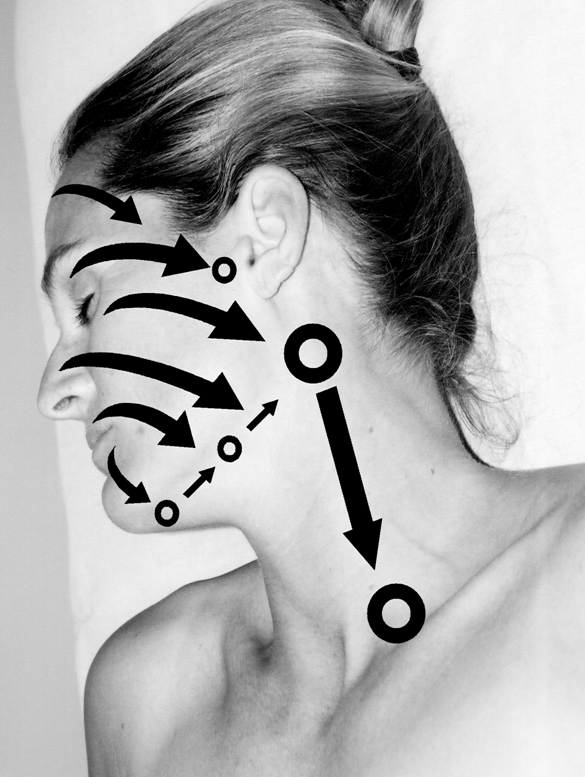
Lymphatic Drainage Pattern Head and Neck
The swelling may involve the eyes, face, lips, neck, or the area below the chin (submandibular), and is usually more pronounced at night or other times of the day when the patient is lying down. In many cases the swelling recedes somewhat during the day when the patient is in an upright position due to lymphatic fluid draining from the head and neck region following the forces of gravity. The swelling is often associated with discomfort or tightness in any of the affected areas, nasal congestion, or decreased vision because of swollen eyelids.
Other functional sequelae may include difficulty swallowing, speaking, or breathing (airway obstruction), drooling or loss of food from the mouth while eating.
Secondary lymphedema of the head and neck, as well as other functional after-effects of cancer treatment in the head and neck region can be significantly improved with complete decongestive therapy (CDT) (2). CDT should be performed by a well-trained lymphedema therapist.
Therapists specializing in the treatment and management of head and neck lymphedema will use a combination of treatment options, to include manual lymph drainage to manually move stagnated lymphatic fluid from the head and neck area into other areas with sufficient lymphatic drainage, skin care, specific exercises and adequate compression therapy, which may involve compression bandages and specific compression garments.
Therapists will also give advice on prevention and managing lymphedema following the treatment phase and instruct patients in necessary self-treatment protocols.
The therapeutic benefit achieved with CDT can often be considerably enhanced by facial exercises, chewing (gum), and meticulous oral hygiene and sleeping in a semi-upright position to counter the negative effects of gravity during times of rest.
 Depending on the location, severity and chronicity of the swelling compression garments for the face are available as neck and chin straps, and partial or full-face masks, which generally include openings for the eyes, nose or mouth.
Custom-made facemasks generally provide firmer and more durable compression, but often have a long turnaround time and are costly to produce. Facemasks made of other materials (often used in burn care and post-facial surgery) are available in a variety of standard sizes and offer a more cost effective solution if the edema is not severe, but tend to be less durable.
 It is crucial that the patient’s airway is not obstructed with use of the garment and careful consideration must be given to the coverage chosen.
Dear Lymphedema Blog Reader – if you like the contents on this website, please help to keep it going. A great amount of work and research is necessary to provide you with up-to-date information on this site. Your donation supports these efforts and associated administrative costs. Surplus funds will be donated to Lymphedema/Lipedema-related charitable endeavors. Please donate using the “Donate Now” button on the right upper hand of this page – Thank You!
Join Lymphedema Guru, a Facebook page solely dedicated to informing about all things related to lymphedema – news, support groups, treatment centers, and much more
(1) http://www.ncbi.nlm.nih.gov/pubmed/21802897
(2) http://www.medpagetoday.com/MeetingCoverage/MHNCS/18779
Further Reading:
1.http://www.cancer.net/patient/All+About+Cancer/Cancer.Net+Feature+Articles/Side+Effects/Head+and+Neck+Lymphedema%A+Swelling+After+Cancer+Treatment
2. http://www.medpagetoday.com/MeetingCoverage/MHNCS/18779
3. http://www.lymphedemapeople.com/thesite/lymphedema_of_the_neck.htm




Leave a Reply