
 Joachim Zuther, Lymphedema Specialist.
 The external support provided by compression garments is an essential component of lymphedema management. Without the benefits of compression therapy, the lymphatic fluid removed by successful treatments would re-accumulate, and long-term management of lymphedema would be impossible.
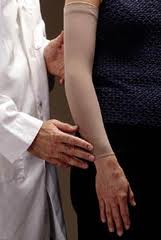
Compression garments for extremities such as sleeves, gauntlets, stockings, and pantyhose, or those manufactured for other parts of the body (vests, brassieres) are available in several sizes, variations, and compression classes. This article discusses the different compression classes suitable for patients affected by lymphedema.
What are Compression Classes?
The level of compression within the different classes is determined by the value of pressure the garments produce on the skin; these pressure values are measured in units of millimeters of mercury (mmHg). For a compression garment to work effectively, the pressure needs to gradually decrease from the most distant part of an extremity (ankle, wrist) to the nearest part (shoulder, hip). This gradient is necessary to avoid tourniquet effects and subsequent obstruction of lymph flow.
Most manufacturers in the United States use the following pressure values within the compression classes:
- Compression class 1: 20-30 mmHg
- Compression class 2: 30-40 mmHg
- Compression class 3: 40-50 mmHg
- Compression class 4: over 60 mmHg
In general, compression levels provided by class 2 garments will be sufficient to prevent swelling in most patients affected by lymphedema of the upper extremity; patients with involvement of the leg will usually require a garment of compression class 3.
However, there are a number of exceptions to this general rule. Some patients with lower extremity lymphedema may require garments of lower compression levels than those provided in class 3, or maybe a garment of a higher compression. Alternatively, patients with lymphedema of the arm may use a sleeve of compression class 1, or even class 3 in some cases.
Many factors must be considered by the physician and/or lymphedema therapist in order to determine the correct compression class for each individual patient. Tolerance to external compression, age, activity level, skin integrity and possible additional conditions, such as arterial insufficiencies or heart problems may influence the level of compression.
Dear Lymphedema Blog Reader – if you like the contents on this website, please help to keep it going. A great amount of work and research is necessary to provide you with up-to-date information on this site. Your donation supports these efforts and associated administrative costs. Surplus funds will be donated to Lymphedema/Lipedema-related charitable endeavors. Please donate using the “Donate Now” button on the right upper hand of this page – Thank You!
Join Lymphedema Guru, a Facebook page solely dedicated to inform about all things related to lymphedema – news, support groups, treatment centers, and much more