
 Joachim Zuther, Lymphedema Specialist.
Unlike the heart in the blood circulatory system, the lymphatic system does not have an active pump to propel lymphatic fluid back to the bloodstream. Effective lymph flow depends on sufficient muscle and joint activity, especially if the functionality of the lymphatic system is compromised. Decongestive exercises are most effective if performed while the patient wears compression garments or bandages, which are also essential components in lymphedema management. Ideally, decongestive exercise protocols are performed two to three times daily for about 10-15 minutes, and the patient should rest with the affected limb elevated for at least 10 minutes following the exercises.
These active, non-resistive and repetitive exercise protocols should be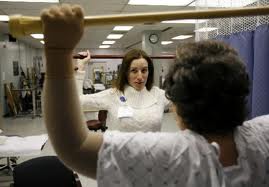 customized by the lymphedema therapist and/or physician to meet individual goals for patients affected by lymphedema. The stage and type of lymphedema, specific restrictions and limitations of joint and muscle activity, as well as additional medical conditions need to be considered.
Breathing Exercises
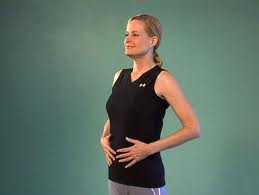 The downward and upward movement of the diaphragm in deep abdominal breathing is an essential component for the sufficient return of lymphatic fluid back to the bloodstream. Patients affected by lymphedema of the leg benefit greatly from an exercise program including diaphragmatic breathing exercises; however, abdominal breathing exercises are also beneficial for patients affected by lymphedema of the arm. The movement of the diaphragm, combined with the outward and inward movements of the abdomen, ribcage, and lower back, also promotes general well-being, peristalsis and return of venous blood back to the heart.
Following are sample decongestive exercise protocols, combined with breathing exercises for the upper and lower extremity, which are published in the book “It’s Not Just a Swelling! Lymphedema”. This book also contains self-MLD and self-bandaging protocols for patients affected by lymphedema. The exercise protocols below serve as guidelines and the movements outlined must not cause discomfort, pain, or soreness.
Before you engage in any exercise program, especially if you have additional medical conditions, please make sure to get your physicians approval.
Decongestive Exercises for the Upper Extremity
- Exercises should be performed wearing compression bandages or compression sleeves (except when exercises are performed in the water)
- Tight or restrictive clothing (tight underwear or bra, heavy breast prosthesis) should not be worn while performing the exercises.
- Exercises should be performed twice daily for about 10-15 minutes. The duration of the program should be slowly increased over a comfortable period of time.
- Movements should be performed in a slow and controlled manner, and the musculature should be relaxed between each individual exercise. The relaxation phase should last at least as long as the time spent during the exercise.
Exercises are performed sitting on stool or a chair without leaning back. Many of the exercises however may be performed lying on the floor. Proper breathing techniques should be used throughout the session.
Abdominal Breathing (3 repetitions)
Place both hands on your belly
Inhale deeply through your nose into your belly (feel how you breathe against your hands)
Exhale through your mouth
Perform breathing exercises as often as possible during the day
Neck Exercises (2-3 repetitions each)
Turn your head slowly and look to the right as far as possible; return to normal position; repeat on the left side
Bend your head to the right and try to touch the shoulder with your ear (do not shrug your shoulder). Return to the starting position and repeat for left side
Shoulder Exercises
“Shoulder Rolls” (3-5 repetitions each)
Rotate shoulders alternately on the right and left side.
Perform shoulder rolls using both shoulders forwards and backwards
“Shoulder Shrug” (3-5 repetitions each)
Shrug both shoulders and inhale. Exhale while the shoulders relax
Arm Exercises (3-5 repetitions each)
Fingers
Place palms and fingers together
Move little fingers away from each other and back together
Move ring fingers away from each other and back together
Continue with each finger
Alternate position:
Hold palms out in front of the body with the palms facing up
Move thumb and index finger together, so the finger pads touch each other, return to open hand
Move thumb and ring finger together, so the finger pads touch each other, return to open hand
Continue with each finger
Hand
Alternate between hands, the relaxed hand rests on the leg
Make a fist and hold for about three seconds
Open the fist and relax the hand for about three seconds
Make a fist and rotate the wrist clock wise and counter-clockwise
Make a fist and touch it to the opposite shoulder
Arm and Hands
“Picking Oranges”
Stretch out arm and lean forward
Make a fist and return hand to leg
“Climb up the Ladder”
Alternate between arms and continue for about 30-40 seconds
Hold arms above head
Grasp rungs of imaginary ladder and “climb” as high as possible (remain seated)
“Swimming”
Use breaststrokes as far as possible to the front, move arms to the side, then to the knees and to the front again
“Push Hand to Opposite Knee” (Alternate between arms)
Place the palm of one hand on opposite knee and push down with hand, and upward with knee
Hold for five seconds
Exercises with a Broomstick (3-5 repetitions each)
“Climb up and down the stick”
Hold the stick vertically between your knees with your hands
Take the stick at bottom with one hand and walk up and down the stick with alternating hands
“Weight Lifting”
Hold the stick with both hands horizontally with the palms up
Lift the stick up and towards your head and return to original position
“Wringing the Stick”
Hold the stick with both hands horizontally with the palms down and about one foot apart
Attempt to wring the stick moving one hand forward and the other back
Hold for about 3-5 seconds and wring in the other direction
“Canoeing”
Hold the stick with both hands horizontally with the palms down and about one foot apart
Start to paddle to either side with nice and big strokes
Decongestive Exercises for the Lower Extremity
- Exercises should be performed wearing compression bandages or compression garments (except when exercises are performed in the water)
- Tight or restrictive clothing should not be worn while performing the exercises
- Exercises should be performed twice daily for about 10-15 minutes. The duration of the program should be increased slowly over a comfortable period of time
- Movements should be performed in a slow and controlled manner, and the musculature should be relaxed between each individual exercise. The relaxation phase should last at least as long as the time spent during the exercise
Exercises should be performed lying supine on the floor, preferably on a cushioned mat or other surface that maintains some firmness. Proper breathing techniques should be used throughout the session. To avoid back strain, a small pillow may be placed under the knees
Abdominal Breathing (3 repetitions)
Place both hands on your belly
Inhale deeply through your nose into your belly (feel how you breathe against your hands)
Exhale through your mouth
Perform breathing exercises as often as possible during the day
Foot and Leg Exercises (3-5 repetitions each)
Toe Clenches (either alternating or with both feet at the same time)
Curl your toes and squeeze for about three seconds
Relax the toes for three seconds
Spread the Toes (either alternating or with both feet at the same time)
Spread the toes as far as possible and hold for about three seconds
Relax the toes for about three seconds
Ankle Curls (either alternating or with both feet at the same time)
Flex the foot as far as possible at the ankle with the toes pointing away from the body (back of the knee remains on the floor)
Hold for about three seconds
Flex the foot as far as possible at the ankle with the toes pointing to the shin
Relax for about three seconds
Ankle Rotation (either alternating or with both feet at the same time)
Rotate foot at the ankle, clockwise and counter-clockwise
“Riding the Bike” (for about one minute)
Lying on your back, move legs in the air as if riding a bicycle
(If you use a stationary bike, keep it on a low setting to avoid soreness or strain)
Heel Sliding
Move the heel of your foot as close as possible to your buttocks
Return to starting position and alternate the leg
Hand and Knee Touch
Lift one knee and push the palm of the opposite hand against knee. Hold for about three seconds
Relax for about three seconds and alternate sides
Butt Lift
Bend the knees and place your feet flat on the floor
Raise your buttocks off the floor and hold for about three seconds
Bring the buttocks back to the floor and relax for about three seconds
Walking
Walking is a great exercise for lymphedema of the lower extremities and can be easily performed while you walk your dog around the block (if you have one). If you use a Stairmaster or treadmill, keep it on a low setting to avoid soreness or strain.
Remember to always try to walk with a normal gait. Do not drag the affected leg and avoid limping.
Additional Resources:
Stretching exercises – video
Arm Exercises (examples) – video
Arm Exercises with a Wand (examples) – video
Leg Exercises (examples) – video
Dear Lymphedema Blog Reader – if you like the contents on this website, please help to keep it going. A great amount of work and research is necessary to provide you with up-to-date information on this site. Your donation supports these efforts and associated administrative costs. Surplus funds will be donated to Lymphedema/Lipedema-related charitable endeavors. Please donate using the “Donate Now” button on the right upper hand of this page – Thank You!
Join Lymphedema Guru, a Facebook page solely dedicated to informing about all things related to lymphedema – news, support groups, treatment centers, and much more