
TweetThe external support provided by compression garments are an essential component of lymphedema management. Without the benefits of compression therapy, the lymphatic fluid removed by successful treatments would re-accumulate, and long-term management of lymphedema would be impossible.
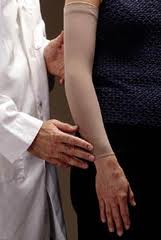
Compression garments for extremities such as sleeves, gauntlets, stockings and pantyhose, or those manufactured for other parts of the body (vests, brassieres) are available in several sizes, variations and compression classes. In this entry I would like to discuss the different compression classes suitable for patients affected by lymphedema.
What are Compression Classes?
The level of compression within the different classes is determined by the value of pressure the garments produce on the skin; these pressure values are measured in units of millimeters of mercury (mmHg). For a compression garment to work effectively, the pressure needs to gradually decrease from the most distant part of an extremity (ankle, wrist) to the nearest part (shoulder, hip). This gradient is necessary to avoid tourniquet effects and subsequent obstruction of lymph flow.
Most manufacturers in the United States use the following pressure values within the compression classes:
- Compression class 1: 20-30 mmHg
- Compression class 2: 30-40 mmHg
- Compression class 3: 40-50 mmHg
- Compression class 4: over 60 mmHg
In general, compression levels provided by class 2 garments will be sufficient to prevent swelling in most patients affected by lymphedema of the upper extremity; patients with involvement of the leg will usually require a garment of compression class 3.
However, there are a number of exceptions to this general rule. Some patients with lower extremity lymphedema may require garments of lower compression levels than those provided in class 3, or maybe a garment of a higher compression. Alternatively, patients with lymphedema of the arm may use a sleeve of compression class 1, or even class 3 in some cases.
Many factors must be considered by the physician and/or lymphedema therapist in order to determine the correct compression class for each individual patient. Tolerance to external compression, age, activity level, skin integrity and possible additional conditions, such as arterial insufficiencies or heart problems may influence the level of compression.
Join Lymphedema Guru, a Facebook page solely dedicated to inform about all things related to lymphedema – news, support groups, treatment centers, and much more

Joachim Zuther, Lymphedema Specialist. 


After a year of wearing (fitted for 2 pair of stockings at the beginning and again after 6 months)–Class 2–Jobst–Elvarex Soft due to allergic reaction to the other material–am getting more and more discouraged and wonder if the garments are doing more harm than good as they continue to cut off my circulation in two areas of the ankle and do not stay up after a few wearings. You mention that there are some made in the U.S., which I would far prefer for a number of reasons, but I am wondering if I should be wearing them at all! And I don’t know which is worse for me–the lymphedema or possible getting blood cuts from the garments I am now wearing. Any advice, suggestions, etc.?
Dear Charlotte:
A compression stocking should never cut into the tissue and disrupt circulation, nor should it slide down. Common reasons why stockings tend to cause tourniquets are either sizing issues, or lack of garment material distribution over sensitive areas. The use of rubber gloves to distribute the garment material has proven to be very effective, and I think you should give it a try. There are also stocking manufacturers offering silicone borders on the upper borders of compression stockings, which prevents sliding.
I am finding it very difficult to even find a reliable company to provide the custom stockings, they won’t take my measurements and then they never do them right, they take up to 12 weeks for pt to get and generally cost more than 500.00
The companies find that the whole process is too complicated and not profitable enough so many in the new orleans area have quit doing customs completely.
Try Luna Medical on line. I have found very helpful, they bill most insurance companies and provide good service. Good luck.
Hallo Herr Zuther,
wir hatten uns letztes Jahr in Australien kennengelernt – ich war mit Herrn von Zimmermann da.
Gratulation zur Ihrem sehr gelungenen Blog!
Ein Kommentar – Class 1 ist in den USA 15-20 mmHg, Class 2 20-30 mmHg usw.
Viele Grüße
Manuela Gassner-Oser
BSN medical GmbH
Hallo Frau Gassner:
Schoen von Ihnen zu hoehren. Ich kann mich natuerlich gut an unser Treffen in Sydney erinnern, und hoffe Ihnen geht es gut.
Ich wuerde Sie gerne an die Wikipedia Seite fuer compression stocking values verweisen: http://en.wikipedia.org/wiki/Compression_stockings#Compression_classes
Auf dieser Seite sind die Kompressionsklassen folgenderweise aufgezeigt:
With the advice or prescription of a physician or medical professional and proper sizing from a trained fitter.
20-30 mmHg
30-40 mmHg
40-50 mmHg
50+ mmHg
Viele Gruesse,
Joachim Zuther
I was told that I had “idopathic edema” (+2-3) in my lower extremities since my late 20′s. (misdiagnosed). Went again to Vascular Surgeon and was diagnosed with Lymphedema…(age 39). Dr. RX 20/30 pantyhose. My question is this..If it affects the entire body…(if dx with lower) I feel I need compression therapy from the upper waist down…(which makes more sense)since the largest of your lymph nodes are in the tummy area…Where can I get (affordable custom made) 20/30 ?’s Thanks for your input !!!!
Dear Alexandra:
Most manufactureres offer a wide range of ready-made compression pantyhose, so you may want to check out sizes before you decide to order a custom-pantyhose. You can check sizing charts for various manufacturers on the Academy of Lymphatic Studies’ website at https://acols.com/ViewProducts.aspx?cid=27&Description=PANTYHOSE
I usually don’t post in Blogs but your blog forced me to, amazing work.. beautiful …
This is such a great resource that you are providing and you give it away for free. I love seeing websites that understand the value of providing a quality resource for free. Thanks for this great resource!
Good blog, where did you come up with the knowledge in this piece of content? I’m glad I found it though, ill be checking back soon to see what other articles you have.
Thank you for another informative blog. Where else could I get that kind of info written in such a perfect way? I have a project that I am just now working on, and I have been on the look out for such information.
Thank you for another fantastic blog. Where else could I get this kind of info written in such an incite full way? I have been looking for such information.
Hola,me interesa muchisimo todo lo referente a linfedema lo padesco desde hace dos años,por una diseccion de ganglios inguinales en la extremidad izquierda,uso las medias Juzo de 30-40 y me han dado magnificos resultados
I have been wearing Juzo compression sleeves and gloves on both arms for the past 2 months due to mild lymphedema after bilateral lumpectomies and sentinal node biopsies (5 and 2 nodes removed). I recently noticed the formation of blisters and irritation under a one inch segment of the upper arm band exactly the pattern of the silicone dots on the band. This has occurred twice, both times on my less affected arm and following exercise on the treadmill. Could this be blistering from the lymphedema or an allergic reaction to the silicone?
Dear Debbie:
I am pretty sure that the blisters are an adverse reaction to the silicone.
I am really thankful to this topic because it really gives great information
[...] Garments: The wearing of compression garments is essential to prevent lymphatic fluid from accumulating in the tissues and conserves the results [...]
I am a C6/7 Incomplete Quad due to an automobile accident in October 2001. Incomplete meaning I have been very blessed to have decent(75%)use of my arms and hands. However, I really struggle with lymphedema from the knees down.. I use Huntleigh Air compression garments while I sleep, and Juzo 3512 AD ll 30 – 40 mmHg when I am up and working. ‘m up for ~17-18 hours daily.
Like Charlotte, my stockings migrate to my instep and create pressure wounds. I use adhesive at the top to keep them in place, and have gone so far as to place little oval foam pads under the paper footie before pulling the stockings on.
Any council would be appreciated.
Regards,
Steve
Dear Steve: The most important issue in your case is to keep the garment from sliding and subsequently creating secondary issues like pressure sores. I would recommend two things – JUZO has stockings with liners (silk/silver) which not only make donning easier, but acts antimicrobial. Secondly I would recommend a silicone border on the top of your knee high garment to prevent sliding.
Hope this helped.
I am always looking for help with my lymphedema even after 25 years. I haven’t found anyone in my northern Colorado area with answers.I had a couple of “kurs” in Hinterzarten, Germany at the Foeldi Kinik when I lived in Germany with great success. My edema is lower extremities due to removal of 21 nodes for cancer, followed by radiation and chemo. A couple of years ago I had a heart valve replacement. I have more peripheral neuropathy now than before. My compression pantyhose dig into my right leg in the thigh area now. Mediven changed their Elegance line that was wonderful. I haven’t found a brand that doesn’t do that or constrict my feet to keep them from going numb either. Any suggestions are welcome.
Dear Holly:
I would suggest to give the “JUZO Soft” a try. All patients I know who use this garment would not want to be without it anymore.
I just started trying to wear Juzo thigh-high, Silver, Made-to-Measure, 34-40 psi, custom leg garments following months of lymphedema treatment. “Trying” is the operative word here. The first time I tried them on, it took 4 hands to get the band to lay flat on my legs. Then I had them on for no more than 5 minutes. Since then I have been released from treatment. Now that I am putting them on by myself, the garments will not stay up. Even if I am successful in getting the silicone thigh band to lay flat within 15-30 minutes after moving around, the garment bands begin to roll and then the stockings either create a tournequette or rolls down my thighs. I use latex gloves to put them on because they allow me to grab the material much better. But that doesn’t help keep them up on my legs. I have already tried the ‘It Stays’ body glue and that doesn’t work for me. Any suggestions? Is it the shape of my legs or are the garments not sized properly? How ‘tight’ around the thighs should the garments be? After reading through other blog comments, I too am concerned about restricting the circulation at the top of my thighs. I have already ordered a pair of full panty hose but as of today, I feel like I have wasted my money on the thigh-highs and they are too expensive to not be able to use.
I have lymphedema after breast cancer. The sleeves ordered for me are always too long and uncomfortable, they also cut into my upper arm. I am told there is nothing they can do about this? Hard for me to believe. What do you suggest?
I am so discouraged with having to live with this condition, it’s embarrassing wearing the sleeve everyone always asks what’s wrong? Not to mention one arm is larger than the other.
Dear Mary: There is absolutely no excuse for comments like “there is nothing that can be done”! Compression sleeves come in a variety of lengths and sizes and should never cause discomfort or a tourniquet effect. I would strongly recommen to locate a lymphedema therapist in your area to get measured for a correctly fitting sleeve. Please use the “Find a Therapist” link on top of this page to locate a therapist close to you.
Good post over again!! I am looking forward for your next post:)
My 12 yr old daughter has mild lymphedema in her right foot and ankle. She has a very thin body, therefore the therapist/specialist was not sure what compression garment for her, claiming the socks and stocking would be too big around her upper leg near her knee(seemed as if she was not confident in her skills and knowledge when it came to treating a child). I wrap her every night with the compression bandages, but I need somthing for her during the day becuase she can’t wear the bandages to school (trying to have as close to normal life style for her. They told me i needed to find her 20-30mm compression garments. There are so many options, I am overwhelmed… any ideas or suggestions/ recommendations from you would be greatly appreciated.
Dear Erricka: It is certainly possible to locate an apprpriate compression garment for your daughter. Manufacturers like JUZO, Medi and Jobst have a large assortment of ready-made compression garments in various sizes and compression classes, and I would suggest comparing your daughter’s measurements with those published by the manufacturers. In the case of your daughter’s measurements not falling within the manufacturers ranges for ready-made garments, a custom made stocking can be obtained. Examples on sizing charts for ready-made garments can be found here: https://acols.com/ViewProducts.aspx?cid=65&Description=20-30mm/Hg CC I
After decongestive therapy I was measured for custom made sleeve. It was had a large gap at the top so a second sleeve was ordered. This one caused deep creases in my wrist area as well as tingling in fingers and change of skin color. I suggested another sleeve in a softer fabric as I have very thin arms. After four weeks I have heard nothing from the fitter. My therapist as suggested a ready made sleeve. I would appreciate some advice.
Ready-made sleeves come in a variety of styles and sizes. If your measurements fall within the manfuacturers measurement guide, I would recommend to order a ready-made sleeve. The measurements should be taken, and the compression class determined by a therapist.